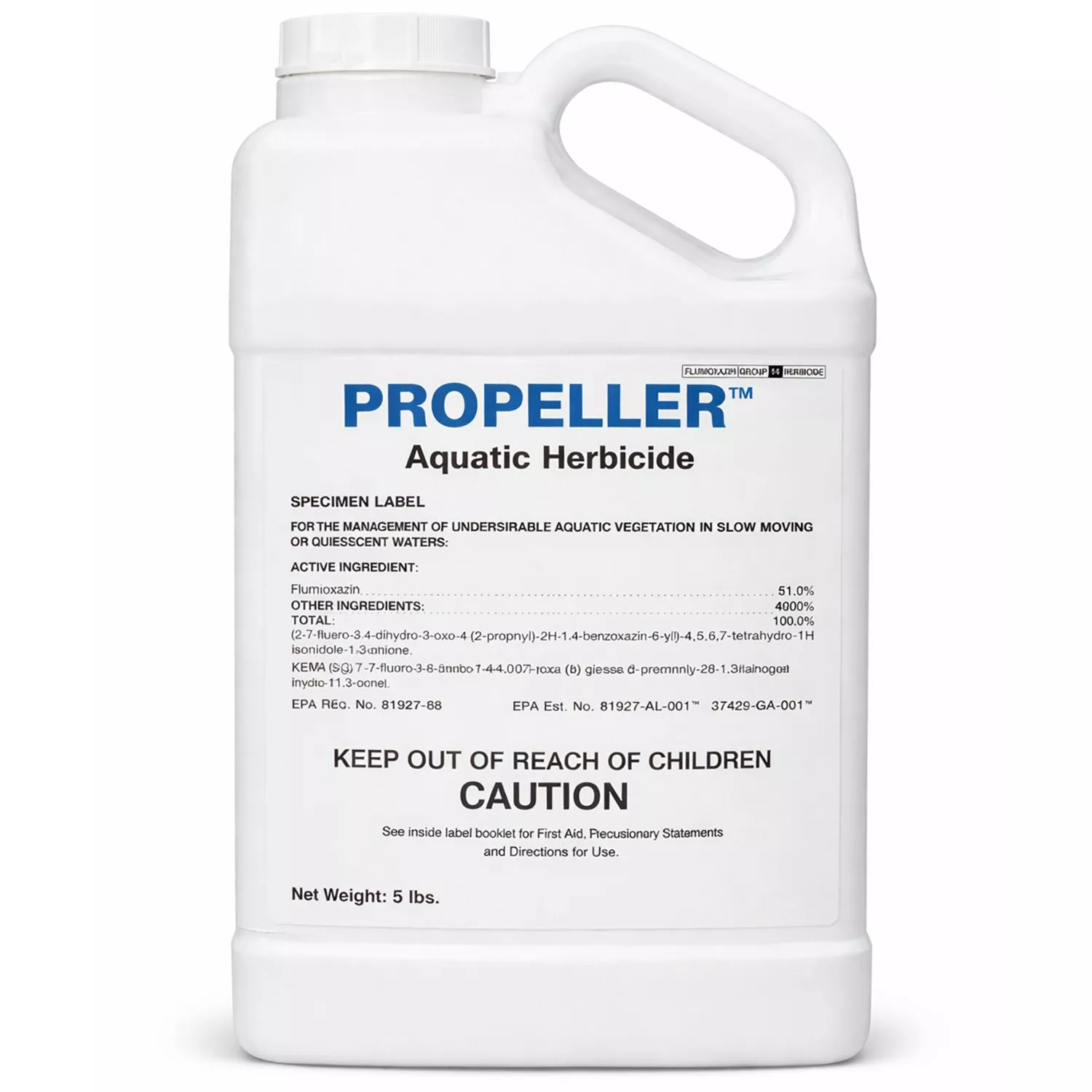
Description
Fast, flexible control for hard-to-manage aquatic weeds
Propeller is a strong fit when you need fast contact control and the flexibility to treat floating mats at the surface or submerged growth in the water column. The water-dispersible granule format pairs clear label rates with flexible application methods, which helps pond managers, lake contractors, and property owners plan small targeted treatments or larger acreage work with less guesswork.
Key Features & Benefits
| Feature | Benefit |
|---|---|
| 51% flumioxazin | Delivers a proven Group 14 contact herbicide for listed aquatic weeds. |
| Water-dispersible granule | Mixes for surface spray or subsurface placement instead of a one-path program. |
| Surface and subsurface directions | Lets you match floating mats, emergent foliage, or submerged weeds with the right approach. |
| Label rate tables | Makes quantity planning easier by acre, water depth, and ppb target. |
| 1 lb and 5 lb sizes | Easier to buy for spot work or broader treatment plans. |
Directions & Dosing Snapshot
| Use Case | Label Rate | Application Notes |
|---|---|---|
| Surface treatment for floating and emerged weeds and filamentous algae | 6 to 12 oz per surface acre | Plus an aquatic-approved adjuvant; apply in a minimum of 30 gal water per acre; retreat only after return and no sooner than 28 days. |
| Subsurface treatment at 1 ft depth | 1.1 / 1.6 / 2.1 lb per surface acre for 200 / 300 / 400 ppb | Early morning application helps improve contact time. |
| Subsurface treatment at 3 ft depth | 3.2 / 4.8 / 6.4 lb per surface acre for 200 / 300 / 400 ppb | Best used on actively growing weeds before surface matting. |
| Subsurface treatment at 5 ft depth | 5.3 / 8.0 / 10.6 lb per surface acre for 200 / 300 / 400 ppb | Trailing hoses improve placement within the plant stand. |
| Subsurface treatment at 7 ft depth | 7.4 / 11.1 / 14.8 lb per surface acre for 200 / 300 / 400 ppb | Do not exceed 400 ppb in any one application. |
Always follow the full label for complete directions, restrictions, and site-specific requirements.
Comparison Table
| Propeller Aquatic Herbicide | Liquid contact aquatic herbicide | Systemic aquatic herbicide | Biological pond-maintenance program | |
|---|---|---|---|---|
| Form / delivery | Water-dispersible granule mixed with water | Liquid spray concentrate | Liquid or granular, chemistry-dependent | Microbes, enzymes, or blended biological products |
| Treatment style | Group 14 fast contact treatment | Contact treatment, varies by chemistry | Slower whole-plant program | Organic-load reduction support |
| Best fit | Listed floating, emergent, and submerged weeds in slow-moving waters | Quick surface-focused work where spray coverage is easy | Longer program control when slower response is acceptable | Long-term maintenance after knockdown or for nutrient-heavy ponds |
| Speed profile | Fast-acting | Varies by chemistry | Varies by chemistry | Gradual |
| Water-use / planning context | No drinking or recreational holding restriction; irrigation limits apply | Varies by label | Varies by label | Varies by program |
Why Choose a water-dispersible granule?
- Quick contact action: A strong fit when you want fast knockdown instead of a slower program.
- Flexible placement: Surface and subsurface directions make it easier to match the weed problem in front of you.
- Smarter quantity planning: Published ppb and per-acre rates help size 1 lb or 5 lb purchases with less guesswork.